Architecture & Data Flow
Understanding the Bridge API ecosystem
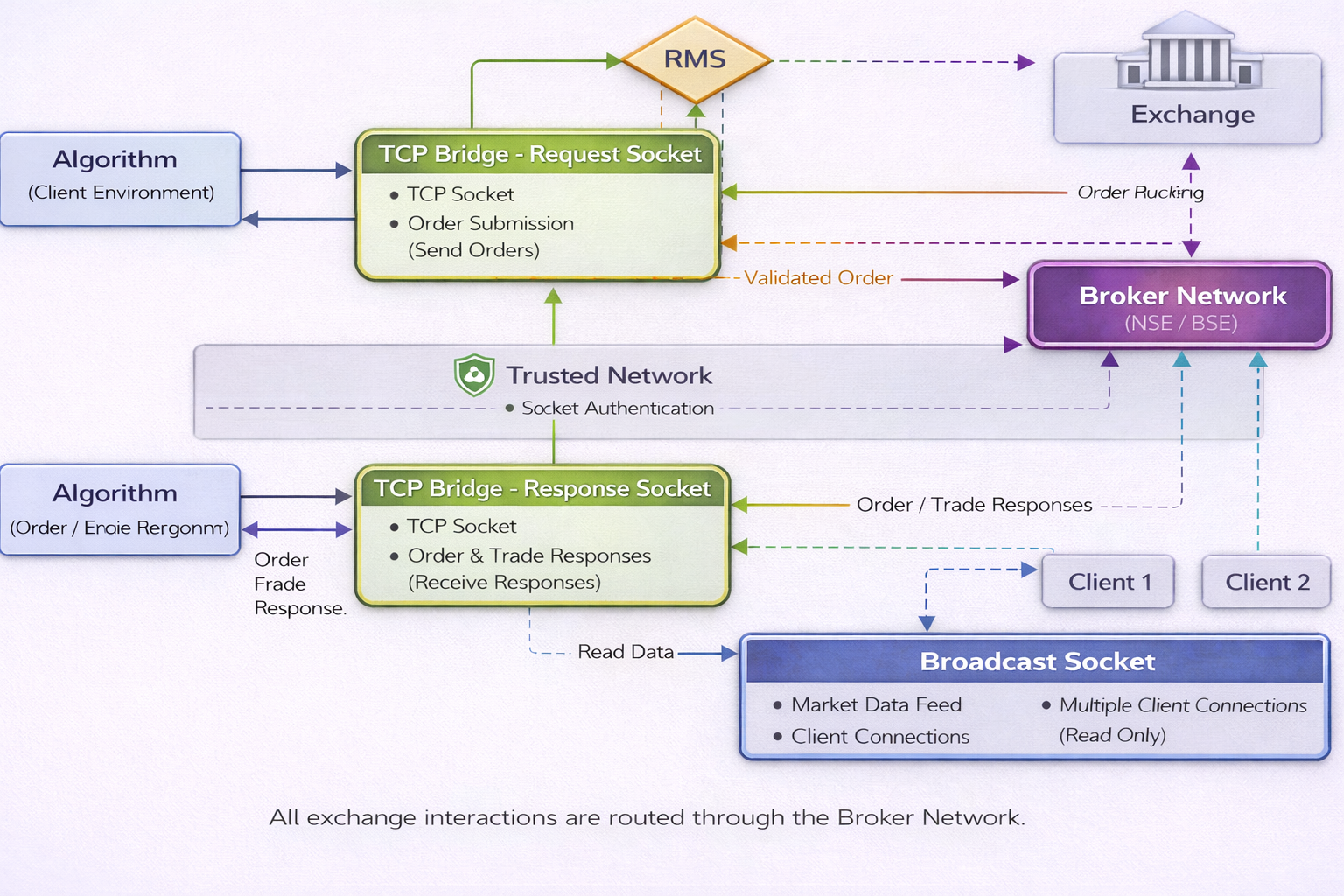
All exchange interactions are routed through the Broker Network
Secure, low-latency socket-based trading solution that lets you execute your proprietary algorithms while keeping your strategy logic completely confidential.
Lightning-fast Bridge API delivering sub-millisecond broadcasts and 2-3ms order execution.
Bridge API for NSE & BSE trading across Equities, Futures, and Options.
Understanding algorithmic trading platforms
Algorithmic Trading Software is an automated platform that executes financial trades based on predefined rules (strategy) using real-time market data and secure exchange connectivity.
For more detailed information, see: Wikipedia - Algorithmic Trading
Algorithmic trading, at its core, means writing code that tells a computer when to buy or sell securities such as stocks, futures, or options. These decisions are based on predefined criteria such as value, time, volume, or other mathematical models. When the criterion logic is triggered, the algorithm automatically performs the trade without human intervention.
This automated process reduces the time interval and removes emotional bias from the trading process.
High-Performance Algorithmic Trading Platform
Chanakya Studio is a high-performance algorithmic trading platform purpose-built for Indian financial markets. It seamlessly integrates live trading with exchange simulation, test market, and mock environments, allowing traders and institutions to confidently develop, validate, and deploy automated strategies. The platform also delivers real-time market data received directly from the broker's network.
Chanakya Studio is custom-compiled and optimized for each client's infrastructure, leveraging the latest GCC and modern software toolchains to deliver exceptional speed, stability, and efficiency. Trading strategies are developed based on client-provided logic and requirements. All such engagements are governed by robust Non-Disclosure Agreements (NDAs), ensuring complete confidentiality and full protection of the client's intellectual property.
A comprehensive and intuitive frontend interface enables users to seamlessly run their algorithms, monitor trades in real time, manage open and pending positions, square off exposures, and review executed trades - all from a single, unified dashboard.
Chanakya Studio provides comprehensive APIs that enable users to develop their own algorithmic trading strategies in C or C++ using Chanakya API. These strategies can be executed directly through the Chanakya Studio platform, ensuring that the strategy logic remains fully confidential and is never disclosed. All executions are handled securely within the Chanakya Studio environment.
Flexible strategy execution with complete confidentiality
Chanakya Studio offers flexible options to users for their strategy development and execution.
We can develop algorithmic trading strategies based on client-provided logic, or alternatively provide APIs that allow users to build and run their own strategies with Chanakya platform without disclosing their proprietary logic.
For users who prefer not to use Chanakya Studio for strategy development—either through us or via our APIs—Bridge API provides an additional option. The Bridge API acts as an intermediary between the exchange and the user. With Bridge API, users can develop their strategies independently in their own environment and execute orders securely through a TCP socket connection, while retaining complete ownership and confidentiality of their strategy logic.
The Bridge API establishes a secure TCP socket connection, enabling users to connect from any trusted machine and transmit order strings generated by their own algorithms. The Bridge API places these orders on the exchange and relays all exchange responses—such as order confirmations, trade confirmations, and rejections—back to the client through the same socket connection.
Lightweight communication layer for seamless integration
The Bridge Connector is a lightweight C-based communication layer that exposes two dedicated TCP sockets for client applications:
Accepts inbound request strings (orders or commands) from client applications
Sends outbound responses (order confirmation, modification, trades, rejection) back to the client
This interface is designed to be:
Plain string messages
Suitable for trading/order flows
C, C++, Python, Java, Perl, etc.
Understanding the Bridge API ecosystem
All exchange interactions are routed through the Broker Network
Lightweight communication layer for seamless integration
| Component | Typical Latency | Peak Load Latency | Description |
|---|---|---|---|
| Broadcast from Exchange to Client | 0.006 ms - 0.011 ms | 0.011 ms - 1.066 ms | Real-time market data broadcast reception and parsing at the client side. |
| Order Request from Bridge API to NIC | 2.1 ms - 2.3 ms | 2.3 ms - 3.1 ms | Processing of order requests, regulatory validations, and transmission to the exchange. |
| Order Response from NIC to Client | 0.06 ms - 0.08 ms | 0.08 ms - 0.11 ms | Order confirmation and acknowledgment processing, followed by delivery to the client. |
Why choose Bridge API for your trading strategies
Run proprietary algorithms without sharing logic
Reliable exchange connectivity and execution
Connect using any TCP socket language
Authentication-protected connections
System-level risk management checks
Continuous market data broadcast
Optimized for high-speed order placement
Works in colo or office environments
Access detailed technical documentation, code examples, and integration guides for Bridge API.
Contact us to discuss your trading requirements and learn how Bridge API can integrate with your strategy.
Contact Us